
Sustainability
SDG 7 Affordable and Clean Energy · Sustainability evidence 2025
Process for carbon management and reducing carbon dioxide emissions
Evidence for the THE Sustainability Impact Ratings 2027 · Indicator 7.2.3 · Reference period: calendar year 2025
Tashkent University of Information Technologies named after Muhammad al-Khwarizmi has a process for managing its carbon and reducing its carbon dioxide emissions. Since 2022 the University has compiled an inventory of its Scope 1 and Scope 2 emissions every year and published it on its website, and its Sustainable Development Policy (TUIT-SP-01) sets the reduction targets the inventory is measured against.
- Scope
- TUIT main campus in Tashkent. Figures cover the main campus; activities of the regional branches (Fergana, Nukus, Samarkand, Nurafshon, and Urgench, which joined Urgench State University in 2025) are mentioned where TUIT took part. Activities described took place at the main campus unless a branch is named.
- Period
- Calendar year 2025 (1 January – 31 December 2025)
- Responsible unit
- Vice-Rector for Finance and Economics; Department of Housekeeping and Landscaping
The annual cycle
| Step | What happens | Who | When |
|---|---|---|---|
| 1. Collect data | Meter readings, utility invoices for electricity, gas and heat, fuel records for vehicles and generators | Department of Housekeeping and Landscaping | January–March |
| 2. Calculate | Scope 1 and Scope 2 emissions in tonnes CO₂e using national grid and fuel emission factors | Department of Housekeeping and Landscaping, with the Department of Energy Supply Systems | March |
| 3. Compare | Results against the targets: −15% by 2030 and −50% by 2040 against 2022–2023, carbon neutral by 2050 or earlier | Sustainability Committee | April |
| 4. Act | Corrective measures agreed and added to the Climate Action Plan | Sustainability Committee | April–May |
| 5. Report | Results published in the annual Sustainability and SDG Report | Department of National and International Rankings | June |
Targets
The Sustainable Development Policy approved on 30 August 2024 (TUIT-SP-01, paragraph 7) commits the University to reduce its Scope 1 and Scope 2 emissions by at least 15% by 2030 and by at least 50% by 2040 against the 2022–2023 baseline, and to achieve carbon neutrality for Scope 1 and Scope 2 by 2050 or earlier. It replaced the Sustainable Development Policy to 2033 and Beyond adopted in 2023.
Data used
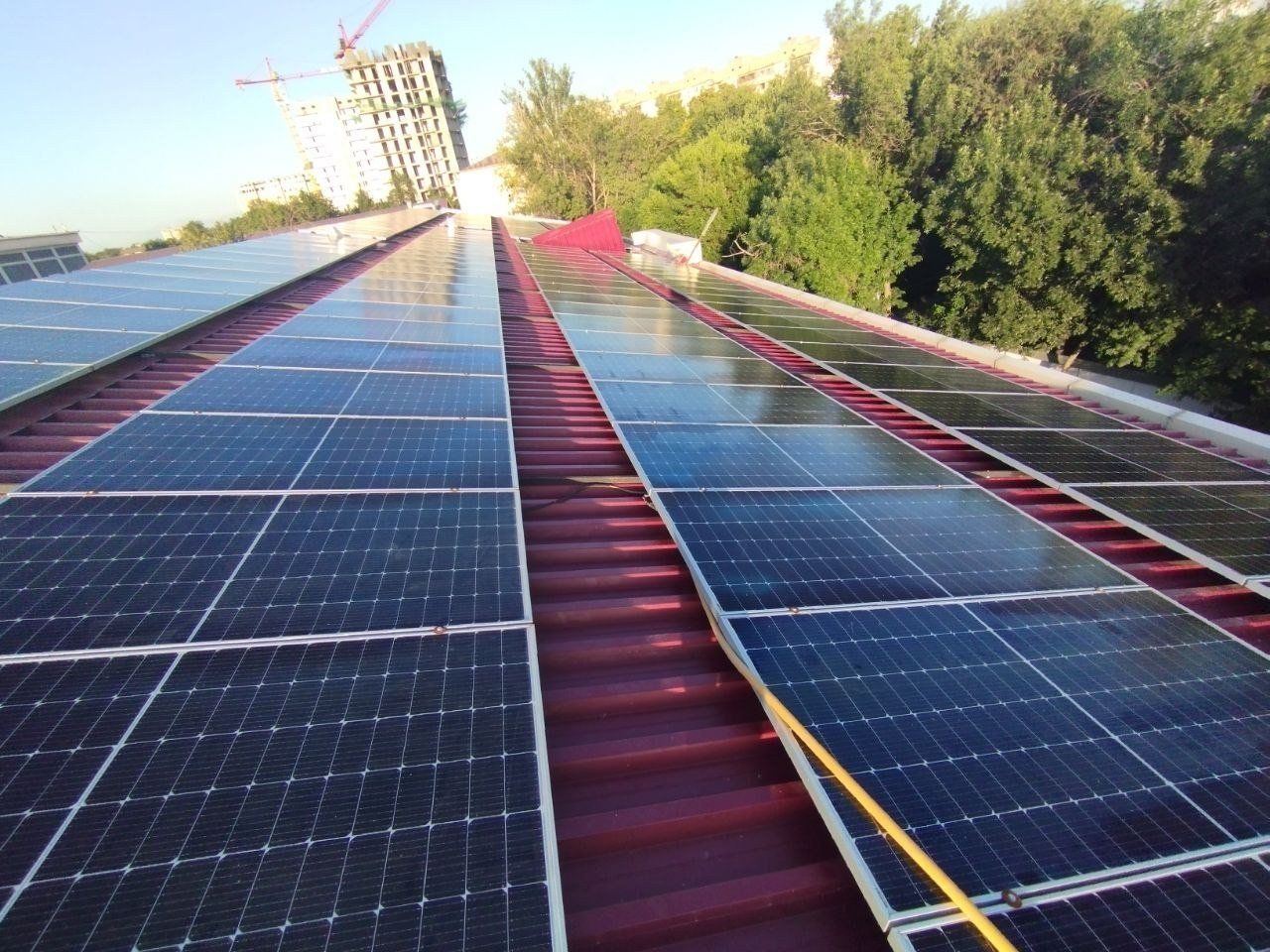
The 2025 inventory uses the following consumption, reported by the Department of Housekeeping and Landscaping: 386,748 m³ of natural gas, 2,331,596 kWh of purchased grid electricity, 4,084.6 Gcal (17,101 GJ) of district heat, 287,036 kWh of electricity from the University’s own solar panels used on campus (981,288 kWh generated in total), and an estimated 24,300 litres of petrol for the University’s 18 vehicles. The 2022–2023 baseline used 234,753 m³ of natural gas and 1.9 million kWh of purchased electricity.
Principles
Emissions are reduced first. Carbon credits count towards the University’s targets only if they are high-integrity credits for permanent removal of carbon dioxide; avoidance credits are not counted.
Results for 2025
| 2025 (t CO₂e) | Basis | |
|---|---|---|
| Scope 1: natural gas | 729 | 386,748 m³ × 1.885 kg CO₂ per m³ |
| Scope 1: vehicle fuel (estimated) | 56 | about 24,300 l of petrol × 2.31 kg CO₂ per litre (18 vehicles × 15,000 km × 9 l/100 km) |
| Scope 2: grid electricity | 1,371 | 2,331,596 kWh × 0.588 kg CO₂ per kWh |
| Scope 2: district heat | 1,130 | 17,101 GJ × 66.1 kg CO₂ per GJ (gas-fired heat) |
| Total Scope 1 and 2 | 3,286 |
The 2025 figures are calculated from the University’s utility records with standard emission factors. Electricity from the University’s own solar plants (287,036 kWh used on campus) has no emissions, and the 694,252 kWh fed into the grid is not deducted. Vehicle fuel is estimated from the number of cars, typical annual mileage and fuel consumption, because it was not metered separately in 2025.
Since 30 August 2024 the process is set out in the Energy and Carbon Management Policy (TUIT-SP-02, paragraphs 9 and 10), and the targets are in the Sustainable Development Policy (TUIT-SP-01, paragraphs 7 and 8).
This page is a public evidence record of Tashkent University of Information Technologies named after Muhammad al-Khwarizmi for the THE Sustainability Impact Ratings 2027 (reference period: calendar year 2025). Enquiries: rankings@tuit.uz.