
Sustainability
Commitment page · SDG 13 Climate Action
TUIT’s commitment to become carbon neutral
Evidence for the THE Sustainability Impact Ratings 2027 · Indicators 13.4.1 and 13.4.2 · Reference period: calendar year 2025
Summary
Tashkent University of Information Technologies named after Muhammad al-Khwarizmi has a target date by which it will become carbon neutral according to the Greenhouse Gas Protocol. The University will achieve carbon neutrality for its Scope 1 and Scope 2 emissions by 2050 or earlier, with cuts of at least 15% by 2030 and at least 50% by 2040 against its 2022–2023 baseline. The commitment applies to the whole university: the main campus in Tashkent and all six branches.
At a glance
- Scope: Scope 1 and Scope 2, and the Scope 3 categories business travel, waste generated in operations and water supply.
- Achieve by: 2050 or earlier for Scope 1 and Scope 2; 2050 for the three Scope 3 categories.
The commitment
The Sustainable Development Policy for the period up to 2033 (TUIT-SP-01), approved by the Council of the University on 30 August 2024, sets the University’s climate targets. Paragraph 7 reads:
The University commits to becoming a carbon-neutral university in accordance with the Greenhouse Gas Protocol. Its targets, against the 2022–2023 baseline, are: to reduce Scope 1 and Scope 2 emissions by at least 15 per cent by 2030 and by at least 50 per cent by 2040; to achieve carbon neutrality for Scope 1 and Scope 2 emissions by 2050 or earlier; and to achieve carbon neutrality by 2050 for the following Scope 3 categories: business travel, waste generated in operations and water supply.
Sustainable Development Policy (TUIT-SP-01), paragraph 7
Paragraph 6 defines carbon neutrality as “a state in which net greenhouse gas emissions within the stated scopes are zero, achieved first by reducing emissions and only then by balancing residual emissions with high-integrity, permanent carbon removals, in accordance with the Greenhouse Gas Protocol”. Paragraph 8 adds that the University’s approach is to reduce emissions first, that only high-integrity, permanent removal credits may be counted towards its own targets, and that avoidance credits are not counted. The Energy and Carbon Management Policy (TUIT-SP-02, paragraph 10) repeats this rule.
Emissions covered
| Scope | What it includes at TUIT | In the target |
|---|---|---|
| Scope 1 | Gas boilers, University vehicles, standby generators | Yes |
| Scope 2 | Purchased electricity and heat | Yes |
| Scope 3 | Business travel, commuting, purchased goods and services, waste and water | Business travel, waste generated in operations and water supply: carbon neutral by 2050; other categories not covered by the target |
The inventory follows the Greenhouse Gas Protocol and is compiled every year from meter readings, utility invoices and fuel records (TUIT-SP-02, paragraph 9).
Baseline, milestones and progress
| Year | Scope 1 + 2 emissions (t CO₂e) | |
|---|---|---|
| Baseline | 2022–2023 | ≈2,690 (gas 234,753 m³ and grid electricity 1,900,000 kWh from the 2022–2023 records; district heat at the 2025 level) |
| Reporting year | 2025 | ≈3,286 (calculated from 2025 utility records; see indicator 7.2.3) |
| Interim milestone (−15%) | 2030 | ≈2,290 |
| Interim milestone (−50%) | 2040 | ≈1,345 |
| Carbon neutral | 2050 or earlier | 0 (net) |
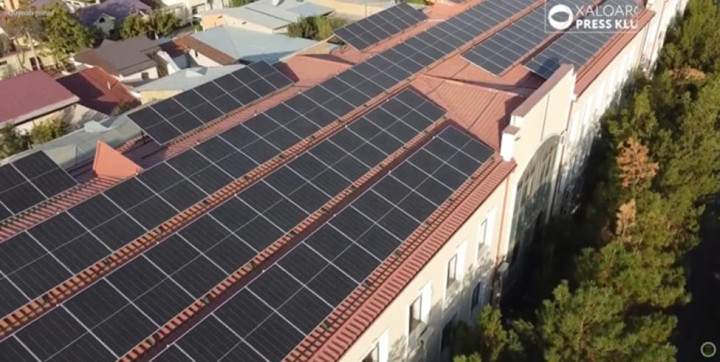
In 2025 the main reduction measure in operation was the University’s own solar generation from 1,366 photovoltaic panels (755 kW, five plants) installed on its buildings under the national programme for state higher education institutions. Further measures, including LED lighting, heating controls and additional solar capacity, are scheduled in the Building Upgrade Plan and the Climate Action Plan.
Approval
- Document
- Sustainable Development Policy for the period up to 2033 (TUIT-SP-01), paragraphs 6 to 8
- Replaces
- Sustainable Development Policy to 2033 and Beyond, adopted in 2023
- Approved
- Council of the University, 30 August 2024
- Responsible
- Rector; Sustainability Committee; Vice-Rector for Finance and Economics
- Reported in
- Annual Sustainability and SDG Report, chapter on SDG 13